vintage_retro_wavy_lines_background-3

Use the build-in ethernet port to control your MaxxFan

Upgrade Your MaxxAir

The VanTurtle Fan Controller provides digital control of up to two MaxxFans through the RJ45 (Ethernet) or RJ11 port already installed on the fan. Pair it with an ESP32 for Wi-Fi access or a Raspberry Pi for seamless integration with Home Assistant,

ethernet

Plug and Play

Connects straight to the fan’s RJ45 or RJ11 port

fan

Full Fan Control

Open, close, speed up, slow down, reverse airflow

chip

Works With Anyting I2C

Compatible with Raspberry Pi, ESP32, Arduino, etc

home-automation

Smart Home Ready

Perfect for Home Assistant automations

vanturtle_conn

Take control

Ever wished you could control your MaxxFan from your phone, automate it to react to temperature, or close it automatically when you start driving? That’s exactly what the VanTurtle Fan Controller makes possible.

Simply plug connect it the fan’s Ethernet port and almost any microcontroller, and you’re ready to go. No need to cut wires or flash custom firmware, just smart control using standard hardware you already know, like a Raspberry Pi, ESP32, or Arduino. You can even use the RJ11/RJ25 port on the fan if you use a crossover cable.

The controller acts as a bridge between your MaxxFan and any digital application. It translates the fan’s proprietary signals into standard I2C commands, so you can integrate it with Home Assistant, write your own Python scripts, control it over Bluetooth, or anything else you can think of. Whatever setup you’re running, the VanTurtle controller fits right in.
Have questions or need a hand? Shoot us an email at questions@vanturtle.com, we’re always happy to help!

IMG_20250716_004451

Endless automation

The board can do anything the button panel on the fan can do: On/off, open/close, in/out, faster, slower, and auto hold. Additionally it can sense if the auto temperature hold mode is on or not and trigger a beep sound from the fan without any changes to the fan configuration. To the fan there is no difference to an actual button press on the button panel or an input through the RJ45 port.

Depending on your setup this will enable you to create automations such as speeding the fan up if temperatures get too high, or even closing the fans when the vehicle starts moving. There is a Python reference library available on Pypi, to quickly start building, but anything that can read and write bytes over I2C will be able to integrate with the controller.

vanturle_design4

Swedish Design

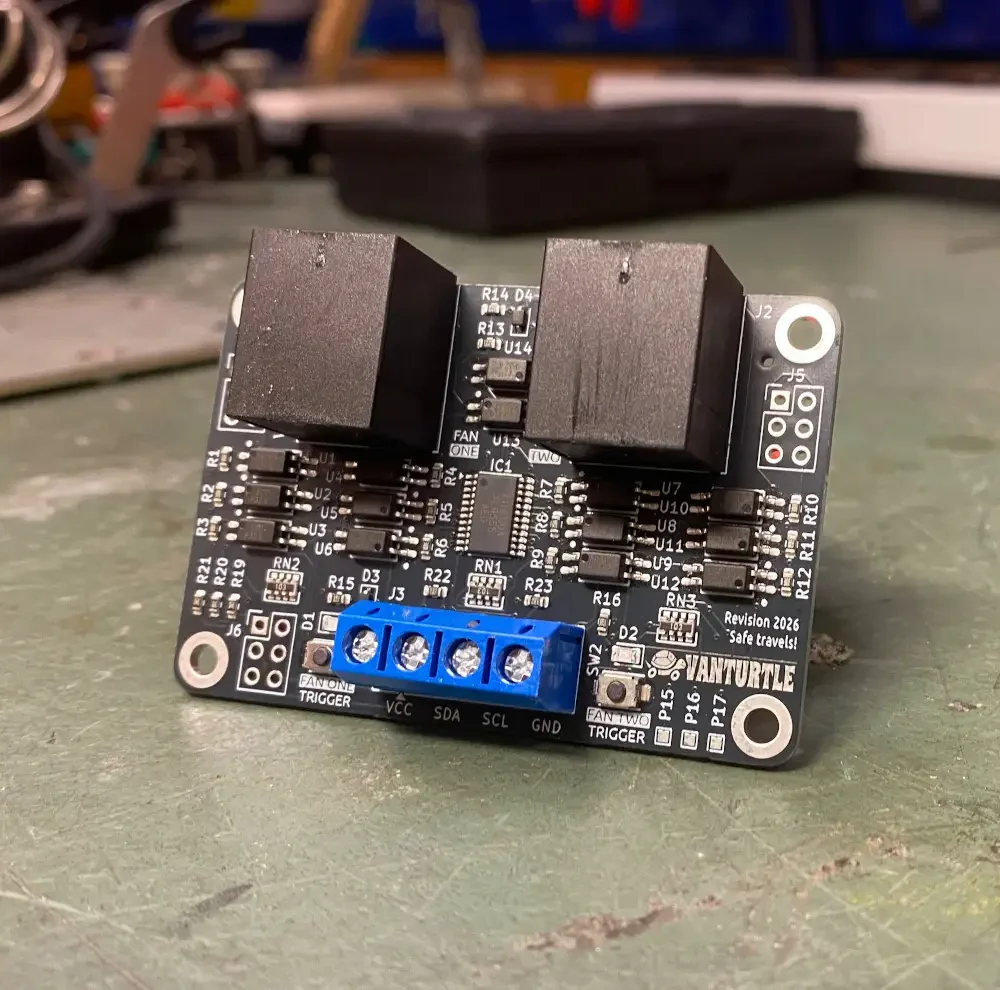
The design of the PCB has been done from the ground up to be compatible with the MaxxFan Deluxe and any other fan that works with the wall remote sold by MaxxAir

  • Independent control of two fans
    Both RJ45 ports function completely independently and can be driven in parallel
  • Voltage swing tolerant
    Tested to handle between 9 and 14 volt from the fan, and between 3,3 and 5 volt on the I2C bus
  • Configurable addressing
    The I2C address can be changed with DIP switches, theoretically supporting up to 18 fans on one bus
  • Compact form factor
    Small enough to mount behind panels or under cabinets without taking up space

Perfect for your build

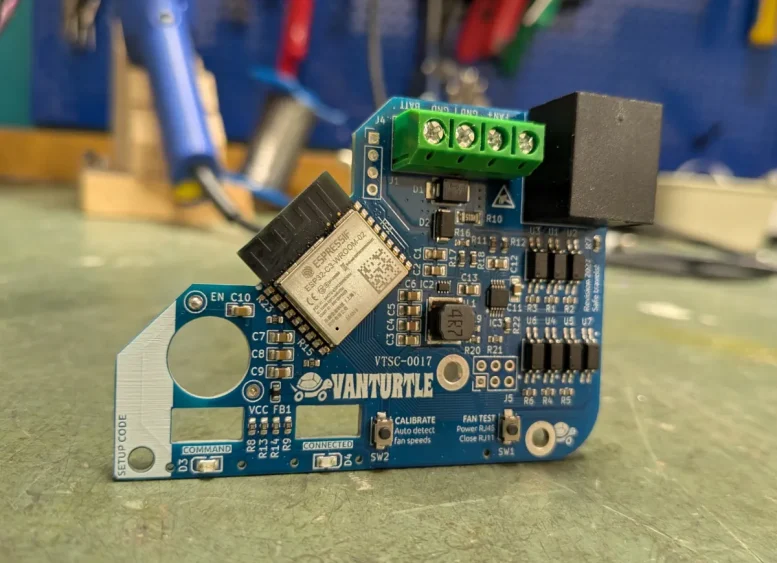
No two van builds are the same, so you can fully personalize the connectors of the controller. You can choose which ports, terminals, and connectors you want, and we’ll hand-solder them onto the board for you. No worries, we make the selection process straightforward and guide you toward the right options for your fan model and setup.

If you prefer a more hands-on approach, you can also order the board with all ports and terminals left unpopulated. That way, you’re free to solder directly to extra pads on the board or use connectors you already have on hand.

Made by fellow travelers

Designed by van enthusiasts for van enthusiasts, the VanTurtle Fan Controller was created for anyone who has experienced having to leave a cozy bed to fetch the remote control. Created to solve our own problems while building a van and refined from there, you can be assured that the card is made to last.

We’re here to help whenever you run into an issue, just shoot us an email!
IMG_0154

Get one from just €9,99

Shipping within the EU for just €4.

Frequently Asked Questions

Will it work with my fan?

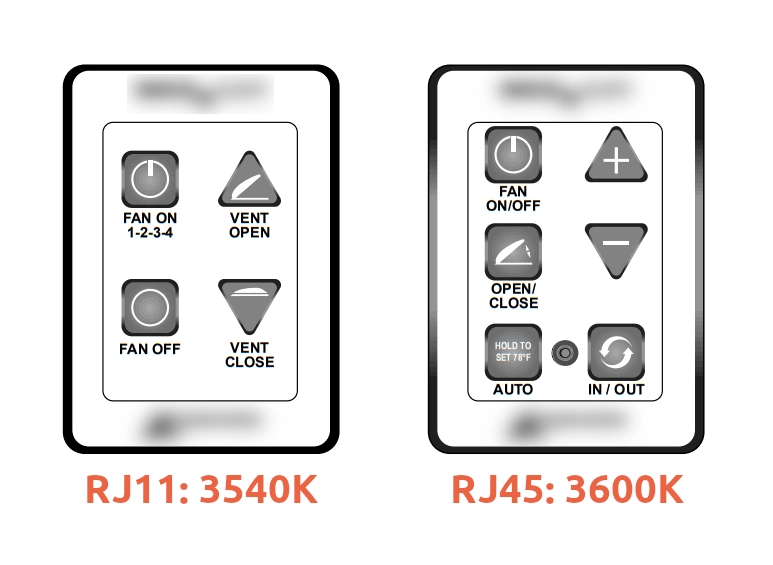
It should work with both the Maxxfan Plus and Maxxfan Deluxe series. If your fan has an 8-pin Ethernet (RJ45) port you should be good to go! Do note that many fans also come with a similar phone plug (RJ11) which does not work with our product.

Known supported model numbers are 4500K, 4700K, 4800K, 4900K, 5100K, 7000K, 7500K, 8500K, 8700K, and 8900K. Many more models probably support it but have not been verified yet.

Can I use this to detect if a fan is on?

Only if it’s in automatic temperature hold mode, because the LED light can be detected. The chip on board the fan does not have any way of outputting its current state, so it’s not possible to easily detect the state or speed of the fan.

If detecting fan speed or on/off state is important to you, please shoot us an email as we’re designing a solution for that!

How does it work?

We emulate a 3650K 6 button wall control panel, but instead of buttons you have to press yourself we use optocouplers to trigger the signals to the fan electronically. The way this works inside the fan is exactly the same as when you press a button on the control panel, so all inputs you can do there can be done by the Vanturtle controller.

Can I use any Ethernet cable to connect it?

We recommend using a quality cable that is rated for Power Over Ethernet. This makes sure that the wire you use actually has 8 strands inside it, as some cheaper cables only have 4 strands total. It’s best to keep the length of the fable under 10 meters (32 feet) to keep the voltage drop within acceptable ranges.
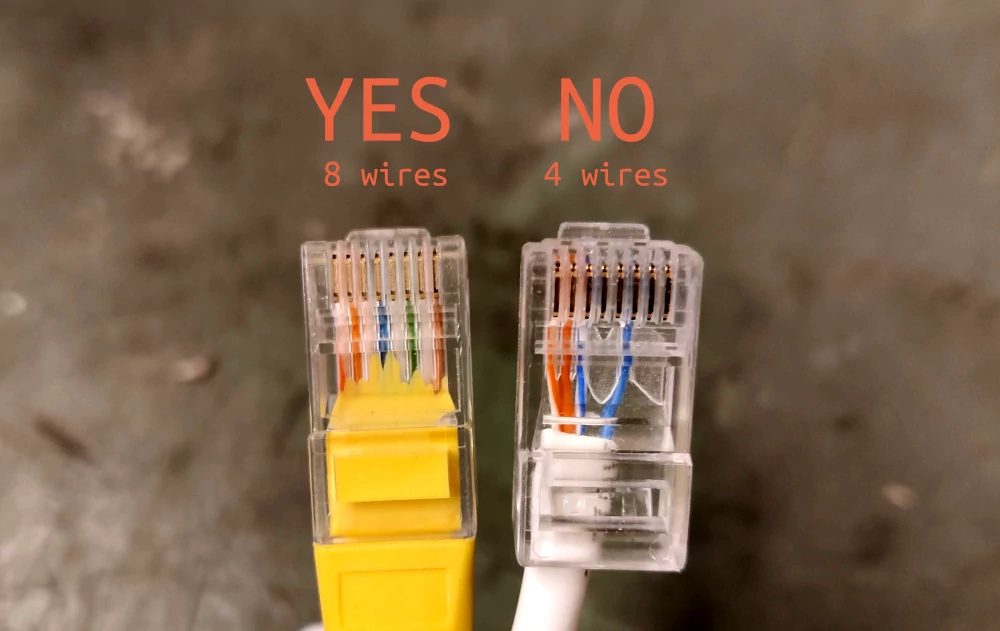
Note however that the Ethernet port is located in a part of the fan that gets almost entirely cut off when you lower the fan onto the ceiling. Using a compact or “short body” Ethernet plug is a necessity.

What kind of protocol does the fan use?

The MaxxFan Deluxe doesn’t use any digital communication protocol like UART, IIC, or CAN. Instead, it relies on simple electrical connections that directly mimic the physical button presses on its control panel. Each button corresponds to a specific pair of wires that, when connected, trigger the same action as pressing the button manually. For example, shorting pins 6 and 8 activates the “Faster” command, while pins 5 and 8 correspond to “Slower”. This makes the fan much easier to control  as no decoding or signal generation is required.

You can read a whole lot more about it in this blog post.

Are you endorsed by Airxcel at all?

Not even a little bit. Maxxair, Maxxfan and Airxcel are all trademarks by AirX Intermediate Inc. and used on this page as an example of products that are compatible with this controller. We have nothing to do with them. We’re just fans.

Is it possible to reliably turn the fan on? (not just toggle its power state)

While the fan limits inputs to an on/off toggle, there is a workaround for this: If you enable auto mode on the fan it will always enter the auto state, no matter if it was on or off before. If you then send an on/off signal it will always turn off. So if you want the fan to turn on regardless of it it was on or off before, you can set your auto mode manually to be very cold and then simply send the auto signal to the fan and it will always turn on.

The board can also read the auto state, so an alternative option is to keep the auto temperature untouched, and turn on auto mode if it is not on already, then turn the fan off and on again. The fan is then guaranteed to be on.

If you’re okay with running a second wire, using the RJ11 port on the fan as well you can guarantee the fan is off or on.

Is it possible to set the fan to a specific fan speed?

Just like with the on/off command, it can’t be done directly but there is a reliable workaround. There are 7 speed levels and if you try to go lower than level 1 it will just beep at you but stay at level 1. So if you send 6 slower signals and 3 faster the fan will always be in a known speed mode of 4. This can be combined with the auto mode trick to “reset” the fan to a known state. Signals can be sent so fast that the fan does not have the time to spin down all the way, so besides the beeping it’s pretty smooth.

Will this work with my MaxxFan if it doesn’t have a remote?

Probably, check your fan for an RJ45 port first before ordering. If the fan has the port or is listed to be compatible with genuine wall mounted control panel then you should be all good to go.

Do I need to modify the fan or open it up?

No modifications are required. Just plug the included Ethernet cable from the fan’s RJ45 port into the controller. We see no reason this should void warranty, as the inputs are the same as pressing the buttons on the fan itself, but we can obviously never guarantee that.

How do I change the I²C address?

There are DIP switches on the board to set a unique address. This allows up to 18 fans on the same I²C bus, use the table below to set the correct address:

1 (A0) 2 (A1) 3 (A3) Address
On (up) On (up) On (up) 20
Off (down) On (up) On (up) 21
On (up) Off (down) On (up) 22
Off (down) Off (down) On (up) 23
On (up) On (up) Off (down) 24
Off (down) On (up) Off (down) 25
On (up) Off (down) Off (down) 26
Off (down) Off (down) Off (down) 27

Still have a question?